Credit, Collections & Insolvency News

Research by Cornwall Insights has predicted that energy bills will rise by an estimated £500 a year despite an expected reduction in Ofgem’s household energy cap.
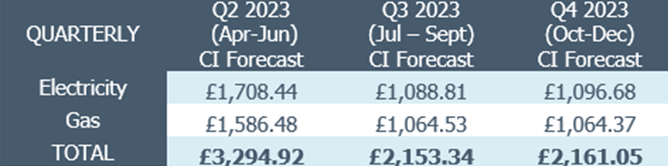
Cornwall Insight predicts the cap for a typical household will be £3,294 equivalent per year meaning that customers will pay about 20% more on their bills, approximately £500, as the government’s energy price guarantee only partially protects consumers from paying the full price cap.
Consumers will not be directly impacted by the price cap due to the Energy Price Guarantee (EPG), which will limit a typical household’s energy bill to £3,000 equivalent per year, a rise from the current rate of £2,500.
If, as forecast, the level of the EPG is lower than the April price cap, the government will pay suppliers the difference. The greater the disparity between the cost of the two schemes the higher the governmental expense. The forecasts show that raising the EPG from £2,500 to £3,000 in April will save the government £2.6 billion across the entire scheme. Based on projected costs, if the EPG were to increase to £3,000 as planned, the estimated cost would be £ £26.8 billion while if it were to remain at £2,500, the estimated cost would be £ £29.4 billion.
Ofgem will formally announce the cap update on 27th February.
Dr Craig Lowrey, Principal Consultant at Cornwall Insight said “Regrettably the forecast for April looks set to leave the price cap above the increased Energy Price Guarantee level, meaning average annual consumer bills will effectively jump by 20% (£500). However, this is before we take into account the end of the £400 energy rebate scheme in March, meaning that the cost of energy for households will increase by even more. While tumbling cap projections are a positive, unfortunately, already stretched households will be seeing little benefit before July.”
“In the latter half of the year, we see a notable shift in our predictions, as the cap falls below the government support price for the first time since the introduction of the EPG in October. This gives us some hope for optimism as far as the wider energy debate is concerned. While prices under the cap remain considerably higher than historic norms, the combination of falling wholesale prices and an increase in the EPG could see the return of competitive tariffs, and with it the chance for consumers to take back some control over their energy bills.”
“Of course, all of these outcomes remain subject to wholesale energy market volatility – the potential for which cannot be discounted while the current energy crisis is still ongoing. As demonstrated by events over the past year, international incidents can significantly impact energy prices, and our dependence on foreign energy imports leaves us more susceptible to global changes. What we can say is current indications show the outlook for energy bills improving, which in itself is a positive sign.”
Cornwall Insight’s Default tariff cap forecasts