Credit, Collections & Insolvency News

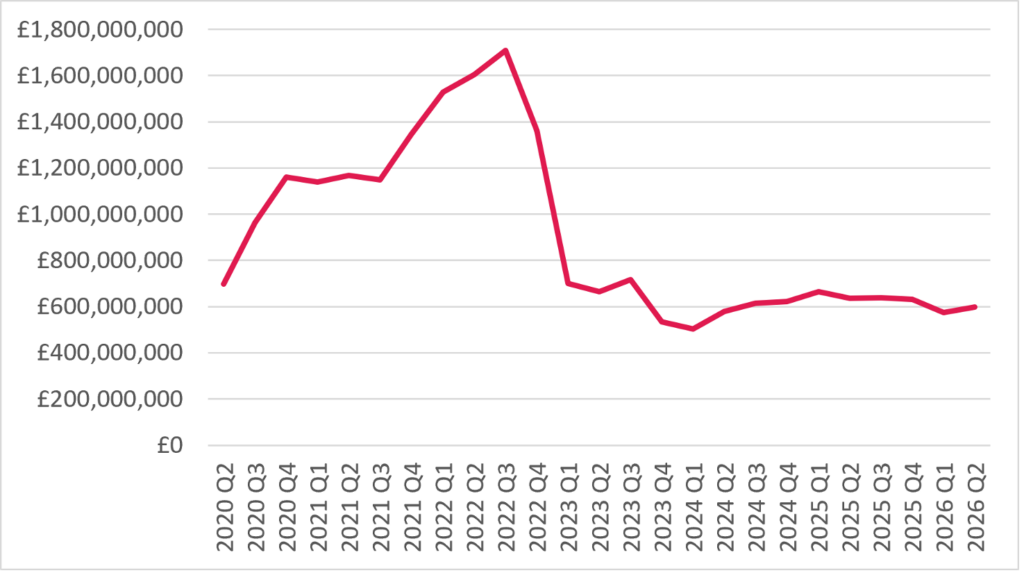
The equity release market returned to growth during Q2 2026, with lending and customer activity increasing as customer demand returned following a slower start to the year.
According to the latest data from the Equity Release Council, total lending increased to £597 million during Q2 2026, up 4% on the previous quarter (£574m). Overall customer numbers also rose 4% to 13,489. The strongest growth came from new customers, with 5,307 homeowners accessing housing wealth for the first time, a 9% increase on Q1 and returning to the same level recorded in Q2 2025.
Existing customers also remained active in Q2 2026. Further advance customer numbers increased 12% to 1,204, while returning drawdown customer numbers remained broadly stable, easing 1% to 6,978.
Although overall lending and customer numbers remained below Q2 2025 levels, the latest figures suggest confidence is gradually returning following the softer first quarter.
Jim Boyd, Chief Executive Officer of the Equity Release Council, said “It is encouraging to see this increase in activity despite the inherent challenge of continuing domestic and international uncertainty. New customer numbers have recovered to the same level as a year ago, while overall lending and customer activity have both increased over the quarter.
“The FCA recently described later life lending as a fourth pillar alongside pensions, savings and investments. Today’s figures suggest that transition is already underway. As retirement funding becomes increasingly dependent on a mix of assets, housing wealth is becoming a more mainstream part of financial planning, supported by stronger consumer protections, greater product flexibility and high-quality advice.”
Average borrowing patterns continued to reflect a cautious approach to accessing housing wealth. Average new lump sum borrowing fell 6% over the quarter to £113,779, while average initial drawdown borrowing increased 2% to £63,642.
Although average drawdown reserve facilities fell compared with Q1, they remained 7% higher than a year earlier at £56,893, suggesting customers continue to value retaining access to future borrowing rather than taking the maximum amount upfront.
Further advance borrowing also strengthened during the quarter. Average initial drawdown further advances increased 11% compared with Q1 to £29,367, while average lump sum further advances remained 6% higher than a year earlier.
Looking forward, adviser sentiment remains cautiously optimistic. More than a third (37%) of firms expect enquiries to increase during Q3, while a similar proportion expect applications (35%) and completions (37%) to rise.
Only one in ten firms expect enquiries to decline, while almost half (47%) anticipate application levels remaining broadly unchanged, suggesting advisers expect recent improvements to continue through the second half of the year.
Advisers also reported that some customers continue to delay decisions rather than abandon them altogether. Almost three quarters (74%) said customers were waiting for borrowing costs to improve, while just over half (55%) cited customers being unable to achieve the loan-to-value they required.
Interest rate expectations also appear more positive, with almost half (47%) of firms expecting rates to be lower than they were during 2025.
David Burrowes, Chair of the Equity Release Council, added “There are no two ways about it: today’s market is very different from that of a decade ago. Customers increasingly want flexibility, choice and the ability to tailor borrowing around changing circumstances, which continues to drive demand for drawdown products.
“As confidence continues to improve, the market is well placed to support more people looking to incorporate housing wealth into their retirement planning. The priority remains ensuring consumers have access to high-quality advice and strong protections so they can make informed decisions that reflect their individual circumstances.”
Simon Webb, Managing Director of Capital Markets and Finance at LiveMore, said “While equity release lending has picked up following a slow start to the year, total lending is still down versus the same period in 2025. We believe this is driven by growing understanding of the wider midlife and later life lending market and the available solutions. Equity release is an important option that will suit some borrowers, but retirement interest only and standard term-based mortgages – whether that’s interest only, capital and interest repayment or part and part – also provide attractive options for borrowers with the right affordability.
“There is still work to be done to educate mortgage advisers on these options, however, and how mortgage advice can and should fit into advisers’ broader conversations with their clients around wealth and retirement planning. The industry needs to take a more holistic view of client finances, realise sufficient planning should start far earlier in a client’s journey and that housing wealth can play a key role in that.
Alice Watson, Head of Home Finance, Canada Life, said “Today’s figures point to steady progress in the equity release market, reflecting that housing wealth is increasingly gaining traction as a core pillar of later life financial planning.
“The feedback from advisers that customers are delaying decisions rather than abandoning them altogether aligns with Canada Life’s own data1. In the first half of this year, against a backdrop of higher interest rates and ongoing cost‑of‑living pressures, fewer customers used equity release to fund big‑ticket items such as holidays and car purchases. Instead, we saw more customers using their property wealth to build financial resilience by clearing existing mortgages or consolidating debts.
“The regulator’s ongoing work to shape the later life lending market and help homeowners navigate their financial lives will drive further growth in the sector. As people live longer and pension adequacy comes under increasing scrutiny, property wealth is set to play an ever more crucial role in helping secure long term financial stability in retirement.”
Total equity release lending, by quarter