
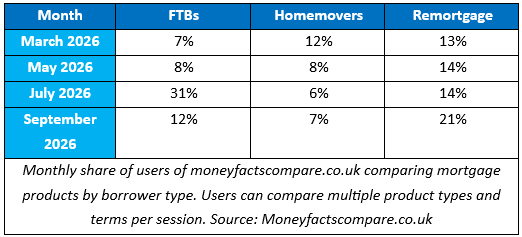
Share of mortgage borrowers researching variable & tracker rate mortgages vs fixed on moneyfactscompare.co.uk
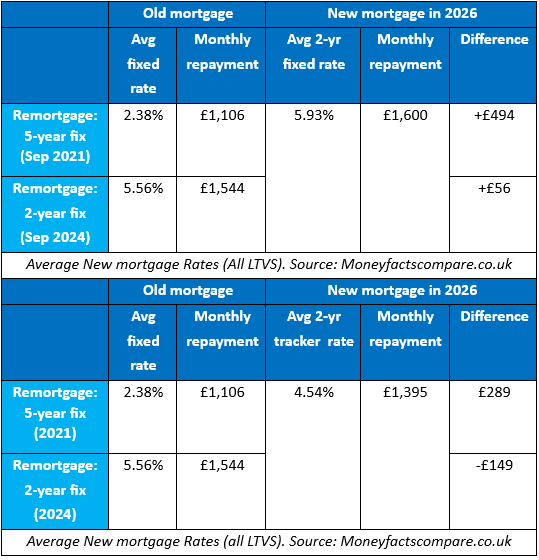
Remortgage repayment costs on a £250,000 mortgage over 25 years


Around one in five remortgage borrowers were considering variable and tracker mortgages in September while first-time buyers’ interest in variable rate products collapsed, new Money Facts analysis has found.
The data in September, 21% of remortgage borrowers researching mortgages on Moneyfactscompare.co.uk were considering variable or tracker mortgages, compared with 14% in July. Whilst 7% of homemovers researching mortgages on Moneyfactscompare.co.uk were considering variable or tracker mortgages, compared with 6% in July.
Meanwhile, 12% of first-time buyers (FTBs) were considering variable or tracker mortgages, compared with 31% in July.
Adam French, Head of Consumer Finance at Moneyfactscompare.co.uk, said “Higher rates are changing borrower behaviour, with around one in five remortgage borrowers researching mortgages on Moneyfactscompare.co.uk considering a variable or tracker mortgage in September, up from a more typical 13 to 14%. It shows a growing number of remortgage borrowers are increasingly prepared to take on some interest rate risk in return for keeping their initial mortgage costs down by looking to variable and tracker rates.
“For someone coming off a very cheap fixed-rate deal, the payment shock can be substantial. A borrower with a £250,000 mortgage over 25 years who secured a five-year fix at 2.38% in 2021 would have been paying around £1,106 a month. Remortgaging today onto an average two-year fix at 5.93% would push that to around £1,600 – almost £500 more every month.
“At an average rate of 4.54%, a tracker can soften that immediate hit. The same mortgage would cost around £1,395 a month which is roughly £200 less than the average two-year fix. But that saving comes with the trade-off that the payment can rise if the Bank of England increases the Base Rate.
“This is a gamble given current rate expectations. If base rate rises as markets expect, tracker borrowers will see their monthly repayments increase, eating into the saving they are making today. Anyone considering a variable mortgage therefore needs to stress-test their budget rather than simply looking at the initial saving.
“First-time buyers have moved in the opposite direction with the proportion of FTBs researching variable and tracker mortgages falling sharply, from 31% in July to 12% in September. It may be that, as the mortgage market has become more volatile, many aspiring buyers have become less willing to take on the uncertainty of a variable rate.
“The calculation is different for remortgage borrowers facing a big jump in their monthly payments. They may be more willing to accept some uncertainty if it gives them a chance to avoid the full extent of that payment shock. But a lower initial payment should not be confused with a guaranteed saving over the life of the mortgage and borrowers need to be confident they can still afford the loan if rates move higher.”
Share of mortgage borrowers researching variable & tracker rate mortgages vs fixed on moneyfactscompare.co.uk
Remortgage repayment costs on a £250,000 mortgage over 25 years

The latest Bank of England Money & Credit statistics for August find that mortgage borrowing increased to £4.4 billion in August, from £4.1 billion in July, but remained below the previous 6-month average of £5.2 billion. Net mortgage approvals for house purchases – an indicator of future borrowing – decreased to 54,900 in August, down…
Read more
Latest Bank of England data shows mortgage approvals fell to 56,100 in July, down from 58,215 in June and below the six-month average of 60,800, as higher borrowing costs weighed on housing demand. The figure was below the average of around 60,800 over the previous six months. Approvals for remortgaging increased to 34,500 from 34,100,…
Read more
New figures released by the Finance & Leasing Association (FLA) show that consumer finance new business in June 2026 was 6% higher than in the same month in 2025. In the first half of 2026, new business in this market was 5% higher than in the same period in 2025. The credit card and personal…
Read more
Two-thirds of homeowners under 30 have mortgages lasting 30 to 40 years, with borrowers typically repaying them by age 59, according to analysis of 190,000 borrowers by Sprive. Analysis of more than 190,000 homeowners shows that two thirds (66%) of mortgage holders under 30 are now on terms of between 30 and 40 years. By…
Read more