

Credit, Collections & Insolvency News

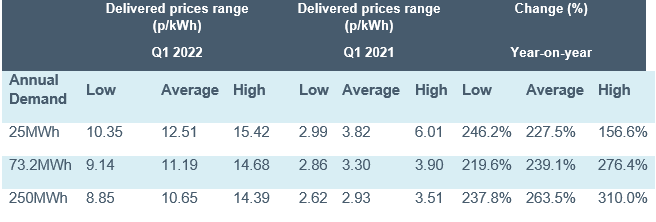
A study by energy analysts Cornwall Insight shows that SMEs have already seen average gas bills climb more than 250% between the first three months of 2021 and Q1 2022.
Analysts looked at delivered gas prices businesses pay on a 1-year acquisition fixed tariff, calculating how much they may pay in future if energy prices continue to rise. They found that while the typical increase will be 250%, some firms could see bills jump 310%.
Wholesale market volatility, amongst other factors, has seen gas prices jump significantly for all consumers. However unlike domestic customers, non-domestic customers have yet to see any dedicated government support to manage the record high energy bills they are facing.
The unstable energy market is also seeing suppliers withdraw tariff propositions at short notice, which is making it harder for business customers to secure the contracts they need, and may lead to them facing higher costs given the nature of this volatility.
Delivered gas prices, 1-year acquisition fixed tariff (Price the SME customer pays minus any commission, VAT & CCL)
Craig Lowrey, Senior Consultant at Cornwall Insight said “The past two years have been incredibly tough for small and medium sized businesses, with many still struggling to keep their heads above water. Record high energy bills will eat further into their profits in an already very challenging economic environment.”
“Volatile wholesale pricing means finding a new contract as a business customer is even more difficult. With many businesses’ supply contracts coming up for renewal in April, there is a significant risk that some will have no choice but to go on to out of contract rates for a period of time. The ones that find deals will still be left with a large increase in bills to contend with – with these costs ultimately being passed on to their customers, further impacting the high cost of living across the country.”
“Calls for an energy price cap for businesses are starting to come through. While this may help in the short-term by protecting business consumers from upfront high costs, as with the domestic cap, it may end up doing little more than deferring problems for a later date.”
“There are also opportunities to look at the demand for gas rather than compensating businesses after the fact. While many SMEs cannot simply reduce gas use, the current high prices mean that those companies with the ability to be flexible in their gas demand due to on-site investments will inevitably look to do so. Therefore, there could be an opportunity to give commercial incentives to those willing and able to reduce their gas use at certain times.”
“High prices and volatility do not appear to be going away any time soon, and it is clear there are many levers to reduce gas prices for small and medium sized businesses that need to be explored. If the government does not want to see more businesses fail, higher product prices for consumers and resultant economic impacts, it will need to start giving them some attention.”