
Credit, Collections & Insolvency News

Millions of people across the UK are still years away from recovering financially from the cost-of-living crisis, and the nation’s overall financial resilience level shows many households are still very exposed if prices rise for basics such as food, fuel and energy, according to new research from Royal London.
The report highlights that one in four UK adults, equivalent to 13,750,000, say it will take them three years or more to recover financially from the cost-of-living crisis.
Our research shows higher living costs continue to affect millions of people’s finances, and any recovery is uneven. Understandably, the more financially resilient groups have been less impacted, but almost half of UK adults (45%) say ongoing higher costs have affected their financial resilience in the last 12 months.
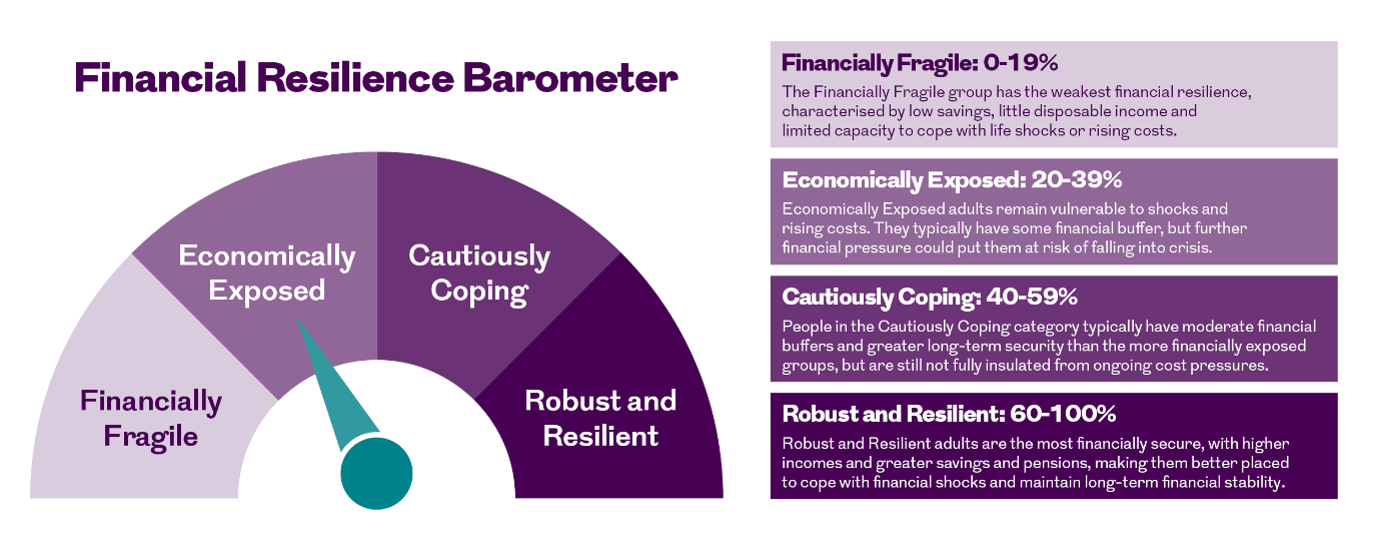
The report, in its third year, introduces a new Financial Resilience Barometer, which gives the overall rating for the UK as ‘Economically Exposed’, with an average score of 33%.
The report found that 30% of UK adults are classified as Financially Fragile, with low savings and limited capacity to cope with financial shocks, with almost one in five (19%) adults having less than £100 in cash savings.
Financially Fragile adults have just £77 of discretionary income each month on average, and more than a third (35%) of employees are Financially Fragile, showing that being in a job does not guarantee financial security.
Homeownership plays a major role in financial resilience. Those who own their homes outright are far more likely to fall into more resilient categories, while renters are significantly more likely to be financially vulnerable.
Income is an important factor, but the research shows that financial vulnerability is not limited to the lowest earners. While lower-income households are more likely to be Financially Fragile, a significant proportion of middle-income households are classified as Economically Exposed, with some higher earners also at risk.
Age also shapes financial resilience. Younger adults and working-age households are more likely to fall into the Financially Fragile and Economically Exposed categories, while those aged 60 and over are more likely to be Robust and Resilient, often reflecting stronger savings and housing positions.
Life events also play a critical role. Four in ten people who have experienced a major life event such as bereavement, illness or job loss in the past two years are financially fragile, compared with around a quarter (24%) who have not experienced a life shock.
Sarah Pennells, Consumer Finance Specialist at Royal London, said “Our research shows that for millions of people, the financial recovery from the cost-of-living crisis will take years rather than months. It’s been over four years since the cost-of-living crisis started, but only three in ten adults, (29%) say they weren’t affected or have already recovered.
“While we’re starting to see some signs of improvement in people’s finances, almost one in five adults (19%) have less than £100 in savings, meaning they have very little by way of a financial cushion. Worryingly, this figure has barely shifted since 2023. A minority of people – one in ten – have less than £50 a month left over once they’ve paid for housing, bills and food. The reality is that millions of people are still living very close to the edge and may be only one bill shock away from a financial crisis.
“Even more concerning is that having a job is no longer a guarantee of financial security, with many working households lacking the savings or financial buffer they need to cope with unexpected spending on repairs or rising prices for goods and services.
“This underlines the importance of building both short-term resilience, through cash savings you can easily access, and long-term security through pensions and financial planning.”